






Hiring for Data: Why Adding an Additional Interview is Risky

Hiring for Data | 3 min read READING TIME

POSTING DATE

category
Hiring for Data
In today’s economic climate, organisations have been keeping a close eye on budgets, and because of this, headcount sign-off has become harder to get. This has started to influence the way that tech companies are approaching recruitment or hiring for data roles.
For example, Ross Henderson, Director and Head of Harnham’s Netherlands branch, has noticed a growing concern among hiring managers and companies to find “the right fit,” and as a result, many have started to add an extra “surprise” interview stage at the end of their recruitment process, after a candidate has completed the specified interviews they were initially prepared for.
While it’s understandable that companies and hiring managers feel the need to ensure their new hires are a good match, Henderson explains why adding an extra interview stage at the very end of a hiring process can be detrimental, and may actually deter top-tier talent from joining your team.
Three Reasons Why You Shouldn’t Add an Extra Interview
Below, we share three reasons why adding an extra “surprise” interview can be a risky move, and what you can do instead to gauge a candidate’s fit without putting them off the role.
Reason 1: Increased chance of losing the candidate to competition
The longer you drag out an interview process, the more opportunity you are giving your competitor to approach your interviewee. The best candidates are typically being approached about multiple roles, and the time added to your hiring process gives more time for other businesses to complete their process, sell their roles, and make offers.
Reason 2: Decreased candidate experience
Candidates often make assumptions about the reason for adding an extra stage. They may come to the conclusion that your company is disorganised, that you aren’t sure on their application or their fit, that you’re holding out for a better candidate, that their expertise is being used for consultancy experience, or the company isn’t serious about the hire. Often, these are unfounded, but based on conversations with candidates, these things come up and can taint the candidates experience and their perception of your organisation.
Reason 3: 50% of candidates said it “puts them off” of a role
We turned to our network of thousands of data professionals on LinkedIn, and ask them via a LinkedIn poll how they felt about an extra stage being added to an interview process after completing the number of interviews specified at the beginning—of the 1,300 respondents, only 5% said they liked it, while 78% said they either felt put off by it or hated it.
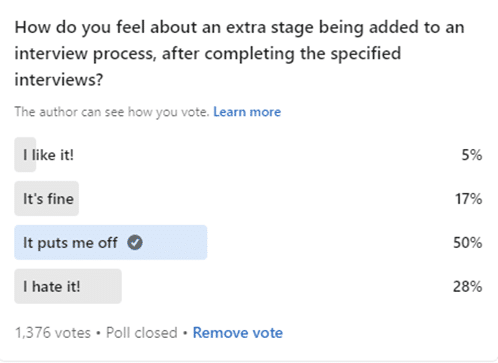
As the data shows, there’s a very high chance that adding an extra interview will give a candidate a negative impression of your organisation, and the reality is there are better ways to thoroughly screen a candidate to ensure the right fit.
Ross’ Recommendations
Of course, there are scenarios where an additional interview is unavoidable. However, there are steps you can take to ensure your candidate’s experience is as smooth and streamlined as possible:
- Really know what you’re looking for: have a clear picture at the start of the process on the competencies, technical skills, and culture requirements you’re looking for. Identify which skills are essential, and which ones are just nice to have. You can do this by putting them into a framework to assess them. This is an important step because it can be easy to get excited by a candidate, only to realise down the line that you hadn’t tested them on several things that are crucial for the role.
- Map out your process beforehand: Figure out how you’re going to test your candidates on the core competencies of the role, ideally in three steps or fewer. Be clear about what needs to be tested and when.
- Loop in the right stakeholders early on: When mapping out your process and defining core competencies, loop in the budget holder, the HR / Talent team, and a specialist recruitment partner. If everyone aligns at this stage, it is less likely to change during the process.
It’s completely understandable that requirements can change during a process and interviewing candidates can sometimes make a manager realise what they need. If that does happen during processes, don’t be afraid to iterate and redefine the process for the new requirements. Proactive communication, and context for candidates, is key.
If your company needs support finding the right data talent, get in touch with our team today.
Author
Share this article
Industry Hub
Related
articles
With over 10 years experience working solely in the Data & Analytics sector our consultants are able to offer detailed insights into the industry.
Visit our Blogs & News portal or check out our recent posts below.

How Much Does an AI Engineer Make in the UK?
How Much Does an AI Engineer Make in the UK? AI Engineers are among the most sought-after…


How to Become an AI Engineer in the UK
How to Become an AI Engineer in the UK AI Engineering is one of the fastest-growing careers…

Why Fintech’s AI Talent Pool Is Smaller Than It Looks
By Luc Simpson-Kent, Business Manager – Harnham The share of US job postings requiring AI skills increased…

The Growing Demand for Commercially Driven Analysts
By Lauren McAlister, Senior Recruitment Consultant – Harnham A big trend we’re seeing in the analytics market…

AI Driven Data – Built in the North and Midlands | How Data Engineers are Using AI to Build Better Data Pipelines
Across organisations, AI is rapidly changing how data-driven teams operate, from how insights are generated to how…

Hiring for Agentic AI in the Netherlands: What We’re Seeing
Recently, we’ve been running a few searches in the Netherlands for people with experience in agentic AI….
AI Driven Data – Built in the North and Midlands | AI in CRO and Experimentation
Across organisations, AI is rapidly changing how data-driven teams operate, from how insights are generated to how…

How Tri-State Insurers Are Using AI to Combat Rising Fraud in 2026
By Conor Larkin, Associate Vice President – Harnham Insurance fraud costs the U.S. industry over $40…

AI in Private Equity: How Talent Strategy Drives Portfolio Value Creation
by Nick Mandella, Director at Harnham. Most PE firms are investing in AI, but returns remain mixed….
How to Choose the Right AI Recruitment Agency in the US
Kyle Arriola, Harnham’s AVP of Data & AI Talent Acquisition, recently spoke with Simon Clarke, CEO of…