






Growing Regulations, Skyrocketing Investment and “Seriously Lacking” Evaluations: Top Takeaways from Stanford University’s 2024 AI Index Report

AI, Artifical Intelligence | 3 min read READING TIME

POSTING DATE

category
AI, Artifical Intelligence
AI has begun to surpass human performance on several benchmarks, including image classification, visual reasoning, and English understanding.
However, standardised evaluations are lacking, and a growing awareness of AI’s potential impact is growing along with a mounting pile of strict regulations.
This is according to the Stanford University 2024 AI Index Report – an annual barometer for artificial intelligence. Recognised globally as one of the most credible and authoritative sources, it comes at a time when AI’s influence on society has never been bigger.
“As AI rapidly evolves, the AI Index aims to help the AI community, policymakers, business leaders, journalists, and the general public navigate this complex landscape,” said Ray Perrault and Jack Clark, co-directors of the report.
“It provides ongoing, objective snapshots tracking several key areas: technical progress in AI capabilities, the community and investments driving AI development and deployment, public opinion on current and potential future impacts, and policy measures taken to stimulate AI innovation while managing its risks and challenges. By comprehensively monitoring the AI ecosystem, the Index serves as an important resource for understanding this transformative technological force.”
Some of the report’s top findings include:
- AI outperforms humans in several areas but not all
Artificial Intelligence has exceeded human capabilities in a variety of tasks, such as image classification and understanding English, yet it falls short in more intricate challenges like high-level maths, visual commonsense reasoning, and strategic planning.
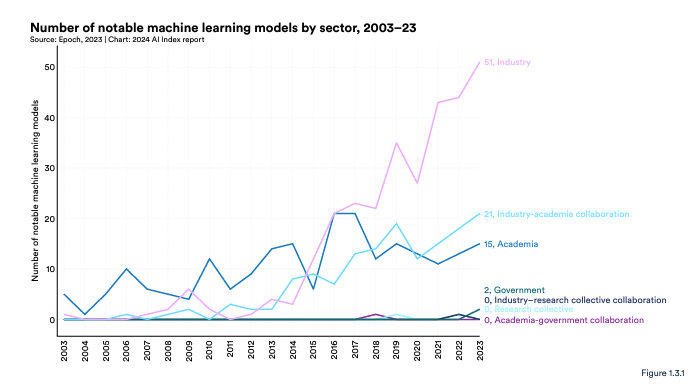
- Industry remains at the forefront of pioneering AI research
In 2023, the commercial sector released 51 noteworthy machine-learning models, compared to just 15 from academic institutions. Furthermore, collaborations between industry and academia produced 21 significant models, reaching a new peak.
- Frontier models become significantly more costly
The AI Index has reported that the costs for training cutting-edge AI models have soared to new heights. Notably, the estimated expenditure to train OpenAI’s GPT-4 was $78 million, whilst Google’s Gemini Ultra required $191 million in computing costs.
- The United States continues to be the primary source of top AI models
In 2023, the US led with 61 distinguished AI models, significantly more than the European Union’s 21 and China’s 15.
- A glaring deficiency in standardised evaluations for LLM responsibility
Research from the AI Index highlights a considerable gap in standardisation for responsible AI reporting. Major developers like OpenAI, Google, and Anthropic predominantly utilise different benchmarks for testing their models, which hinders the ability to uniformly assess risks and limitations.
- Investment in generative AI soars
Despite a downturn in overall private AI investments last year, funding for generative AI rocketed, increasing almost eightfold from 2022 to total $25.2 billion. Key industry players such as OpenAI, Anthropic, Hugging Face, and Inflection achieved notable investment rounds.
- AI demonstrably enhances workforce productivity and quality of work
Studies from 2023 suggest that AI boosts worker efficiency and enhances the quality of their work. These findings also indicate AI’s role in narrowing the skills gap between different levels of workers, although some research warns of reduced performance if AI is used without adequate oversight.
- AI-driven acceleration in scientific progress
AI’s role in propelling scientific innovation deepened in 2023 with the development of applications like AlphaDev for more efficient algorithmic sorting and GNoME, which aids in materials discovery.
- A marked rise in AI regulations in the United StatesThe past year saw a substantial increase in AI-related regulations, with the count rising from a single regulation in 2016 to 25 in 2023, reflecting a growth of 56.3% over just one year.
- Global awareness and apprehension regarding AI’s impact grow
An Ipsos survey indicates that over the past year, awareness of AI’s significant potential impact in the near future has risen from 60% to 66%. Additionally, 52% of respondents expressed increased anxiety about AI, a rise of 13 percentage points from 2022. In the US, Pew data shows that 52% of Americans feel more concerned than excited about AI, up from 38% the previous year.
You can access the full report HERE.
—
Be a catalyst for salary transparency. Gain a better understanding of your value. Keep salaries competitive. Take part in Harnham’s 2024-2025 Data & AI Salary Survey HERE.
Artificial Intelligence has exceeded human capabilities in a variety of tasks, such as image classification and understanding English, yet it falls short in more intricate challenges like high-level maths, visual commonsense reasoning, and strategic planning.
In 2023, the commercial sector released 51 noteworthy machine-learning models, compared to just 15 from academic institutions. Furthermore, collaborations between industry and academia produced 21 significant models, reaching a new peak.
The AI Index has reported that the costs for training cutting-edge AI models have soared to new heights. Notably, the estimated expenditure to train OpenAI’s GPT-4 was $78 million, whilst Google’s Gemini Ultra required $191 million in computing costs.
In 2023, the US led with 61 distinguished AI models, significantly more than the European Union’s 21 and China’s 15.
Research from the AI Index highlights a considerable gap in standardisation for responsible AI reporting. Major developers like OpenAI, Google, and Anthropic predominantly utilise different benchmarks for testing their models, which hinders the ability to uniformly assess risks and limitations.
Despite a downturn in overall private AI investments last year, funding for generative AI rocketed, increasing almost eightfold from 2022 to total $25.2 billion. Key industry players such as OpenAI, Anthropic, Hugging Face, and Inflection achieved notable investment rounds.
Studies from 2023 suggest that AI boosts worker efficiency and enhances the quality of their work. These findings also indicate AI’s role in narrowing the skills gap between different levels of workers, although some research warns of reduced performance if AI is used without adequate oversight.
AI’s role in propelling scientific innovation deepened in 2023 with the development of applications like AlphaDev for more efficient algorithmic sorting and GNoME, which aids in materials discovery.
An Ipsos survey indicates that over the past year, awareness of AI’s significant potential impact in the near future has risen from 60% to 66%. Additionally, 52% of respondents expressed increased anxiety about AI, a rise of 13 percentage points from 2022. In the US, Pew data shows that 52% of Americans feel more concerned than excited about AI, up from 38% the previous year.
Author
Share this article
Industry Hub
Related
articles
With over 10 years experience working solely in the Data & Analytics sector our consultants are able to offer detailed insights into the industry.
Visit our Blogs & News portal or check out our recent posts below.

How Much Does an AI Engineer Make in the UK?
How Much Does an AI Engineer Make in the UK? AI Engineers are among the most sought-after…


How to Become an AI Engineer in the UK
How to Become an AI Engineer in the UK AI Engineering is one of the fastest-growing careers…

Why Fintech’s AI Talent Pool Is Smaller Than It Looks
By Luc Simpson-Kent, Business Manager – Harnham The share of US job postings requiring AI skills increased…

The Growing Demand for Commercially Driven Analysts
By Lauren McAlister, Senior Recruitment Consultant – Harnham A big trend we’re seeing in the analytics market…

AI Driven Data – Built in the North and Midlands | How Data Engineers are Using AI to Build Better Data Pipelines
Across organisations, AI is rapidly changing how data-driven teams operate, from how insights are generated to how…

Hiring for Agentic AI in the Netherlands: What We’re Seeing
Recently, we’ve been running a few searches in the Netherlands for people with experience in agentic AI….
AI Driven Data – Built in the North and Midlands | AI in CRO and Experimentation
Across organisations, AI is rapidly changing how data-driven teams operate, from how insights are generated to how…

How Tri-State Insurers Are Using AI to Combat Rising Fraud in 2026
By Conor Larkin, Associate Vice President – Harnham Insurance fraud costs the U.S. industry over $40…

AI in Private Equity: How Talent Strategy Drives Portfolio Value Creation
by Nick Mandella, Director at Harnham. Most PE firms are investing in AI, but returns remain mixed….
How to Choose the Right AI Recruitment Agency in the US
Kyle Arriola, Harnham’s AVP of Data & AI Talent Acquisition, recently spoke with Simon Clarke, CEO of…